Blog · Published August 25, 2026 · Updated October 6, 2026
Field sanitation rules for Salinas Valley growers and labor contractors
Cal/OSHA §3457 and Monterey County's field toilet program set how many toilets and handwashing stations a crew needs, and how close. Here are the rules with worked crew examples.
Fast answers
- Delivery areaRanches from Castroville to King City and into nearby counties. Check your ZIP.
- ArrivalMon–Fri. Book 2+ business days ahead; harvest weeks fill first.
- Which unitStandard toilets plus handwash stations; towable units for moving crews. Field setups.
- CleaningWeekly pump, clean and restock on a set service day.
- Full costBilled per 28-day cycle; the quote lists units, delivery and pickup, service and tax.
Mon–Sat, 7 a.m.–7 p.m. · Most callers get an itemized quote in under 10 minutes.
Cal/OSHA
What does Cal/OSHA §3457 require for field toilets?
Cal/OSHA §3457 requires growers to provide separate toilets for each sex for every 20 field workers or fraction of 20. It also requires 1 handwashing facility for every 20 workers. Both must sit within a ¼-mile walk or 5 minutes of the crew, whichever is shorter, and be kept clean and stocked.
| Requirement | What 8 CCR §3457 says (plain words) |
|---|---|
| Toilets | Separate facilities for each sex, for each 20 employees or fraction of 20 |
| Fewer than 5 employees | 1 single-user, all-gender toilet is enough |
| Handwashing | 1 facility for each 20 employees or fraction of 20 |
| Distance | Within a ¼-mile walk or 5 minutes, whichever is shorter |
| Upkeep | Serviced and maintained at all times, following public health sanitation practice |
| Records | Written service and maintenance records, kept for 2 years |
Please note: This guide explains the rules in plain words. It is not legal advice. Confirm your setup with Cal/OSHA and Monterey County Environmental Health.
The legal minimum and our recommendation are not always the same. Below, we show both, and label which is which.
Worked examples
How many toilets and handwashing stations does a field crew need?
A field crew needs 1 toilet per 20 workers of each sex and 1 handwashing station per 20 workers. A mixed crew of 12, with 8 men and 4 women, needs 2 toilets and 1 handwashing station. A crew of 45, with 30 men and 15 women, needs 3 toilets and 3 handwashing stations.
| Crew (example) | Men's toilets | Women's toilets | Total toilets | Handwash stations |
|---|---|---|---|---|
| 4 workers | — | — | 1 all-gender (under 5) | 1 |
| 12 workers: 8 men, 4 women | 1 | 1 | 2 | 1 |
| 20 workers: 14 men, 6 women | 1 | 1 | 2 | 1 |
| 25 workers: 15 men, 10 women | 1 | 1 | 2 | 2 |
| 45 workers: 30 men, 15 women | 2 | 1 | 3 | 3 |
| 80 workers: 50 men, 30 women | 3 | 2 | 5 | 4 |
How the math works
Count each sex on its own, divide by 20, and round up. 30 men ÷ 20 = 1.5, which rounds up to 2 toilets, and 15 women ÷ 20 = 0.75, which rounds up to 1.
Then divide the whole crew by 20 for handwashing: 45 ÷ 20 = 2.25, so 3 stations.
Our recommendation, not a legal rule: on hot days or long shifts, add 1 spare unit per crew so a line never forms. The crew calculator runs the same math for you.
Distance rule
How far can a field toilet be from the crew?
A field toilet and handwashing station must be within a ¼-mile walk or 5 minutes of where the crew works, whichever is shorter. On a big ranch, a crew can walk out of range in a single morning. So field units often need to move with the crew, block by block.
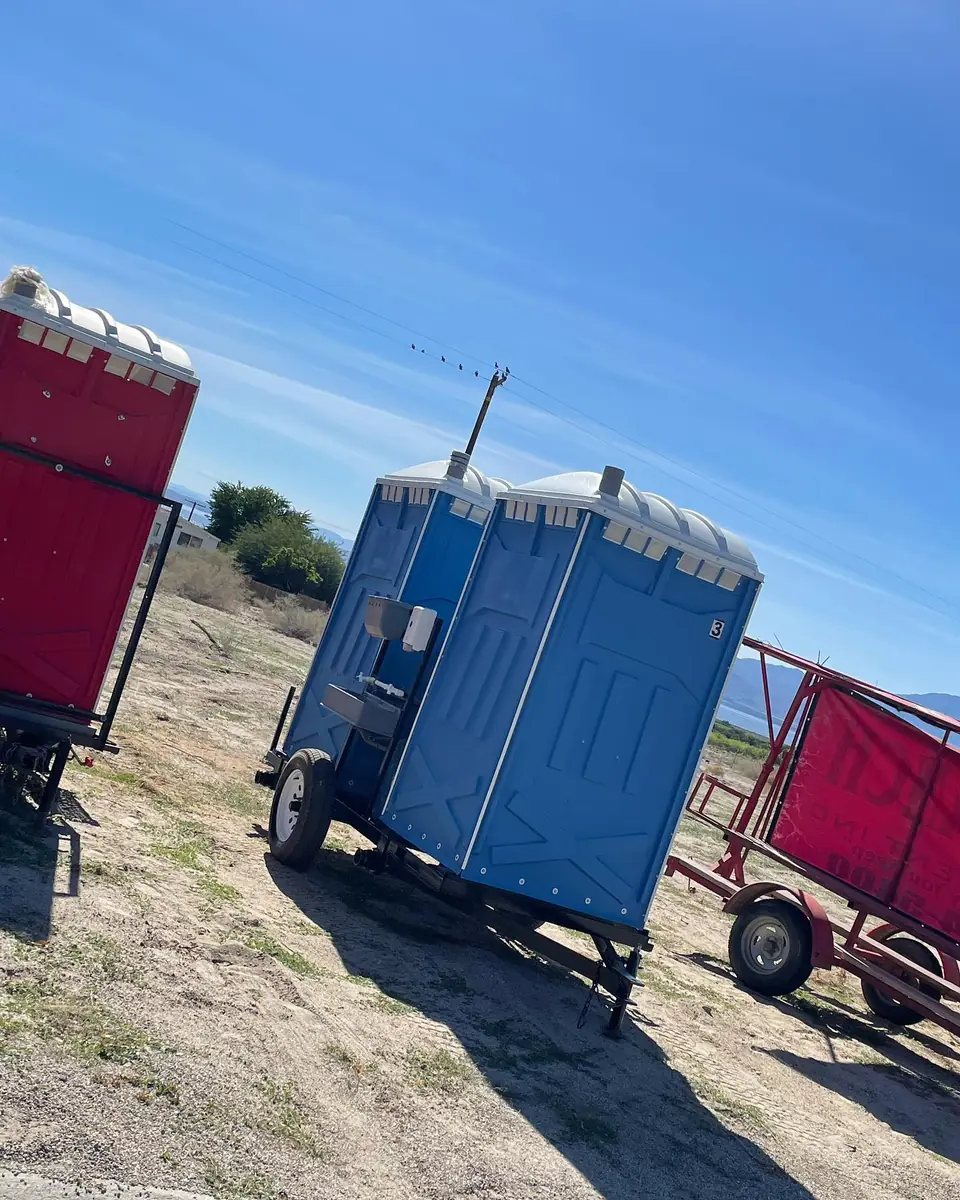
Towable units on a trailer make that easy. The crew boss hitches up and moves the units to the next block. Fixed units work for crews that stay in one block for days.
- Measure the walk from the farthest row, not from the road
- If a ditch or a fence forces a long way around, measure that path
- Move units when the crew moves, not at the end of the week
- Set the door away from the afternoon wind and stake the units
Monterey County
What does Monterey County's agricultural field toilet program add?
Monterey County Environmental Health runs an Agricultural Field Toilet Inspection Program on top of Cal/OSHA's rule. Under the county program, field toilets need a waste tank of at least 40 gallons, and handwashing units need at least 15 gallons of water. Permits renew every year in April.
| County program point | Plain-words meaning | How our units compare |
|---|---|---|
| Toilet tank ≥ 40 gallons | Small camping-style toilets do not count | Standard unit tank is about 60 gallons (typical for the class) |
| Handwash water ≥ 15 gallons | Enough water for a crew's shift | Handwash station holds about 34 gallons (typical for the class) |
| Within ¼ mile / 5 minutes | Same distance as Cal/OSHA | Towable units can move with the crew |
| Annual permit, renewed each April | Plan the renewal before the season starts | Ask the county who must hold the permit for your operation |
Tank sizes are typical for each unit class. The exact model is confirmed on your quote.
Records
What field sanitation records should a grower or labor contractor keep?
Cal/OSHA §3457 requires written service and maintenance records for field toilets, kept for 2 years. Each record should show the date, the unit, the location and what was done. Our weekly service runs on a set day, which makes each entry easy to log.
- Service date and time for every unit
- Unit location (ranch, block or crew)
- Tank pumped, unit cleaned, paper and soap restocked
- Handwash water refilled
- Any repair or replacement
- Crew size on peak days
Keep one folder per season. If a unit moves with a crew, note the new block each time. Each 28-day invoice has its own quote number, so file those with the log.
“They have been just horrible about getting them pumped out.”
Site manager describing a previous vendor
“I don't think I'm going to need it cleaned weekly right away, since the work will be sporadic.”
Landscape contractor
That second caller is common on work that starts and stops. For sporadic sites, every-other-week service is possible. For a full field crew, weekly service is the safer fit.
Exceptions
Are small crews or short shifts treated differently?
Small field crews are treated differently: under Cal/OSHA §3457, a crew of fewer than 5 employees can use 1 single-user, all-gender toilet. The rule also has limited exceptions for very short work periods, where transport to a facility can stand in. Read the exact text before relying on any exception.
Exceptions are narrow and fact-specific. A crew that works 90 minutes in one field and then moves to another is still on the clock all day.
On our rental line, farm calls were rare: 1 of 78 recorded calls from 2025–2026 came from a ranch. That caller needed a unit for 30 days. Most growers book through the season, so the 28-day billing cycle is worth understanding first.
Season setup
How do you set up field sanitation for a Salinas Valley season?
Set up field sanitation in 6 steps: count each crew by sex, set the unit and handwash numbers, choose fixed or towable units, confirm the county permit, book 2 business days ahead, and keep weekly service records. Peak harvest weeks fill early, so book before the crew arrives.
- 1
Count the peak crew
Use the biggest day of the season, split by sex.
- 2
Do the math
1 toilet per 20 of each sex; 1 handwash per 20 workers; round up.
- 3
Fixed or towable
Towable units for crews that move often; fixed units for crews that stay in a block.
- 4
Check the county permit
Monterey County field toilet permits renew each April.
- 5
Book the season
Book 2+ business days ahead. Long-term units bill every 28 days with weekly service.
- 6
Keep the records
Log each week's service visit. Keep the records for 2 years.
A Salinas dispatcher answers
Are your crew's field toilets set before harvest starts?
Tell us the crew size, the ranch location and how often the crew moves.
Mon–Sat, 7 a.m.–7 p.m. · Most callers get an itemized quote in under 10 minutes.
What does a field toilet and handwash setup cost per 28 days?
On recent quotes, a toilet plus handwash combo ran about $495 per 28 days with weekly service. A single long-term unit ran about $185–$295 per 28-day cycle, plus a one-time delivery and pickup charge. Your itemized quote is the final price.
Do you have towable units that move with the crew?
Yes. We rent porta potties on a towable trailer for crews that change fields often. The crew can move them to stay inside the ¼-mile, 5-minute range.
Who keeps the field sanitation service records?
The employer keeps written service records for 2 years under §3457. Our weekly service runs on a set day, and each 28-day invoice carries a quote number. Ask dispatch at booking what else you need for your file.
Does a 34-gallon handwash station meet the county's 15-gallon minimum?
Yes. A handwashing station in this class holds about 34 gallons of fresh water, which is more than the county's 15-gallon minimum. The exact model is confirmed on your quote.
Who holds the Monterey County field toilet permit?
Ask Monterey County Environmental Health which party must hold the permit for your operation. Permits renew each April, so check before the season starts.
Is a 2-person crew required to have separate men's and women's toilets?
No. Under §3457, a crew of fewer than 5 employees can use 1 single-user, all-gender toilet. Confirm your situation with Cal/OSHA.
Fastest: call (831) 260-5800
How do I get an itemized porta potty quote?
Calling is faster — a dispatcher can check the route and your ZIP while you are on the line. Prefer to type? Send these six details and we text or call back with every line item: unit, delivery and pickup, servicing, any rush fee, and tax.
- No phone tree — a person in Salinas answers
- Every fee named before you pay
- Weekend events: we drop Friday, pick up Monday at no extra charge
- Long-term units serviced weekly on a 28-day cycle
Mon–Sat, 7 a.m.–7 p.m. Form replies within 1 business hour during open hours.